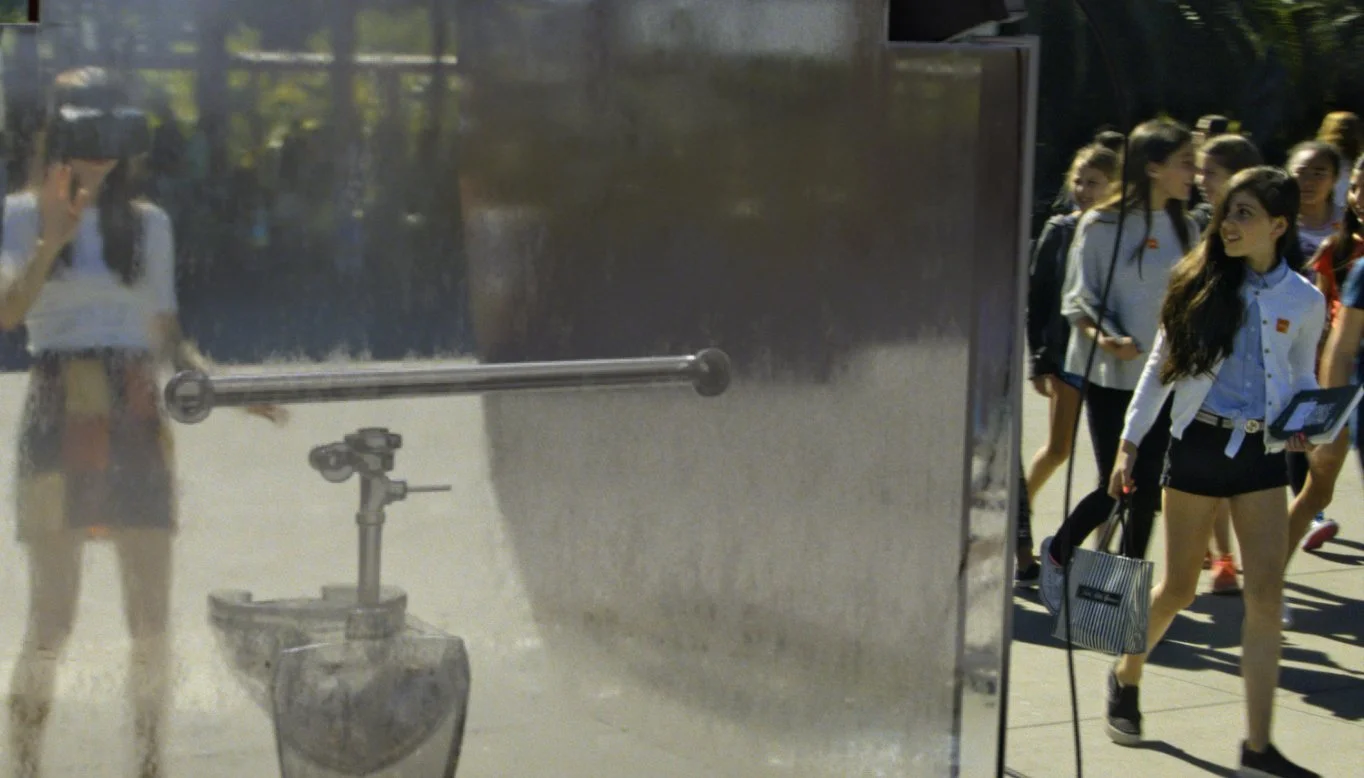
The LACMA Toilet Retrospectives
Note that this project was not selected, if you are interested in developing a toilet retrospective for your institution please reach out directly.
LACMA Toilet Retrospective
Site Specific Art has historically been seen as art placed in site, creates the specificity of the site as art. Examples of artists working in this form are myriad, from Robert Smithson to James Turrell. The ground signifier being that the work once installed is permanently bound to the space it resides. First the work, then the space, then the two together, permanently bound in both reality and consciousness.
I would like to explore site before it has been touched by the artist. To extract its essence, repositioning it in virtual space, and exploring it out of time/space. The site is unharmed. Where once the viewer has experienced this virtual reproduction, they can examine the real, and experience it as if the artist has never touched it. The space, then art, then the two separate, only the viewer’s consciousness has changed, binding them within their mind.
This is the inner form of this work, the outer form deals with what one would historically call relational art.
I would like to put my finger on the problematic social aspect of virtual reality and then push. The optics of a human with head mounted display inside a plastic box feeling around is intentionally macabre, to generate the proper amount of cultural energy to begin conversation. The topic being, “The Commodification of Consciousness: is it really that bad of a future for humanity?”, again comically pushing on the wound in our future that virtual reality has opened up.
Why do you consider this project to be a meaningful exploration of emerging technology? (250)
Contemporary virtual reality was originally approached from the video game industry, allowing for immersive, albeit low quality, rendering of a computer generated environment. This form of virtual world is rendered every 1/70 th of a second on the graphics processing unit, thus limiting the quality/resolution of the resulting world inhabited. It made sense that the beginnings would come from the game world, as 3d games have pioneered the first person experience via the first person shooter.
With the creation of stereoscopic “360 degree” based camera rigs, film began to adopt 5 virtual reality as a platform. While inherently photorealistic, this method locked the the viewer to specific optical point in space. From this single point everything looks correct, however as one tries to move their head within the 3d volume, the VR generated world does not track, breaking the illusion, and causing the world to seem projected onto a dome surrounding the viewer. “360 VR” rendered animated movies suffer from this same issue.
Within the last 6 months, new methods have begun to arise which allow for both the ability to explore a computer generated space, while also generating a higher quality rendered image. Particularly the advent of lightfield and point based methods in both rendering and live action space acquisition. These method’s ability to render a VR environment at a photorealistic level, allows the viewer to move their head, and walk inside of a virtual world rendered at a level not yet seen (please see video for more information).
In what ways does your project inspire dialogue about the issues at hand, including the relationship between technology and culture? (250 word maximum)
I am somewhat conflicted about virtual reality as a space for creative work, I keep getting the feeling that I may be helping to bring about my own doom, but I just cannot help myself. On one side, the benefits are obvious. VR offers the space to engage with sculpture, architecture, and the gallery in ways one is not capable of doing in real life. The laws of physics simply do not apply, reality itself becomes malleable. The agency this releases for the artist is shocking, only the tingling feeling that it’s all fake, brings one back to “reality”.
This tingling points to the horror of the singularity: will the Information Age give way to a Virtual Age? I can’t help but feel that there is a choice coming. When the inability to control the world we live in, gives way to one which we can control, where those who are not born with the silver spoon, a perfectly symmetrical face, or simply the “correct” genitalia, can choose to have a world where these “errors” never happened. What might a future where widespread virtual or analog reality look like? Is this so bad? Who are we to criticize one’s preferred form of reality? Are there prescient “canaries in the coal mine” in our society today, which can give us a taste of how culture might react to these forms of living? How will capital effect the coming of virtual/augmented living?
Please describe your proposed plan for public engagement. What opportunities do you foresee to share prototypes, demonstrations and process with the public? (100 word maximum):
Site Specific Virtual Installation: The “LACMA Toilet Retrospective”
VR boxes around the LACMA campus for 2 weeks, free and open to all.
Tours to and of the bathrooms, both male and female, docent lead or artist lead.
Generating a people’s history of bathroom stories, recordings to be played during the conversations below.
Lectures or Mini-Conference titled: “The Commodification of Consciousness: is it really that bad of a future for humanity?”
Those working in the field of virtual reality Dystopian authors touching on this field (Cyberpunk),
Neuroscientists who focus on consciousness
What data will your project produce that may be of interest to other artists, technologists, or arts organizations? (250 word maximum):
Beginning to define best practices: topics such as nausea, audience wait times, safety, hygiene, docent interaction, and even fear of embarrassment of using the technology, might be useful to document. A pre and post experience evaluation could be filled out by each audience member and indexed for later reference. A cultural index of “bathroom stories”, could be documented and shared via an online resource for other artists interested in the bathroom as a space for art practice and critique. These stories would be optional, and completely anonymous, with available recording devices on site. They could be categorized, digitized, and organized in such a way that those interested in finding out about a particular topic in relation to the bathroom could simply type a particular query. In just the short time I’ve discussed this project with friends, I have received many different anecdotes and feelings about the bathroom. I could see this as a growing space of conversation over the course of this project’s installation, and possible installations at locales around the world.